Photo
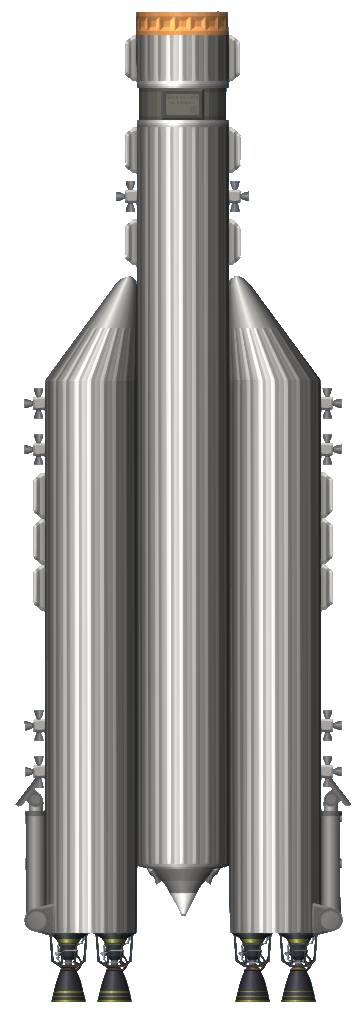
The Delta-class 1st Stage Booster was the Imperial Space Administration's first design at a reusable booster system to deploy satellites and other equipment into Low Earth Orbit. The big test was to build the Orbital Science Space Station. After a total number of 13 launches utilizing 7 of the Delta-class Boosters, it took 1 Month and 8 Days for the Station to be completed. After then, the system was also used to launch a multitude of Satellites for CosmoCast Shazbotdom (A subsidiary of Shazbotdom News Corporation) and to launch a large grouping of CubeSats for a University from an Allied nation. As of now, the booster's main process is to launch Resupply and Crewed Missions to the Orbital Science Space Station and the occasional launching of sections to the new Orbital Transfer Station.
The Second Stage Gamma-class Booster is the secondary boosting mechanism for the Low to Mid-Orbit Launch System. It's purpose is to give the push of launches to get equipment up to an orbital height of ~110km.
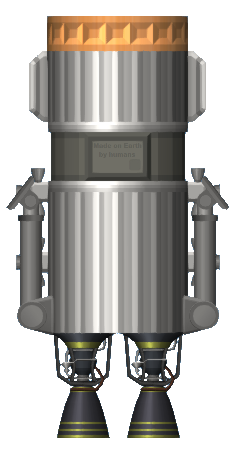
The Epsilon-class Orbit was designed as the primary booster system for the 3rd Generation Space Capsule. Its purpose is to push the capsule into its final orbital trajectory to complete docking procedures with the Orbital Research Space Station. It is also the primary mode of transporation to return the Space Capsule back to Earth. Utilizing the engines to decelerate from orbit, it has landing legs, RCS Thrusters, and a parachute to assist in landing operations to bring anywhere from 3 to 6 Astronauts to the space station and back to Earth.
The updated Epsilon-class v2 Orbiter is completed and is now paired with the 4th Generation Capsule, where the docking ring is moved from sides of the orbiter to the top of the cone and the parachute is integrated into the body of the capsule and moved off of the nose cone. There is also the addition of a Launch Abort System (LAS) onto the top of the capsule, which will be utilized in case there is a catastrophic system failure. This system will eject and catapult the Capsule away from the rest of the Full Stack, where it will be able to successfully land to keep the astronauts safe.
The design of a vessel, built off of the design for the platform for the Space Station Cargo Transport is utilized to delivery the Crew for the Mars Colony Transfer Vessel.The Xi-class Vessel is currently in its testing phase and will be undergoing SubOrbital Test Launching soon. Afterwards it will go into service.

The main workhorse of the Cargo Transportation Fleet for the Orbital Science Space Station, the Omega-class specialty cargo transporters are designed to connect with the lowest docking segments of the Space Station so that Scientists can unload any and all equipment and new Research Projects onto the station as quickly as possible, utilizing the large docking ports at the top end of the transport ship. The vehicle is also designed to the point that it can bring up new equipment to replace old, outdated, and/or broken computer equipment.
These Cargo Transporters are designed to have a total lifespan of 25 years before they need to be replaced. As of right now, the Imperial Space Administration has plans for at least two replacements for the Omega-class, with production of the prototypes of these two replacements. There is no official word of when these prototypes will be finished, they are being designed by two different private corporation teams. Imperial Space Expeditions Incorporated has the contract for one of the Prototypes while The Imperial Scientific University at Fairbanks is holds the contract for the second of the Prototypes.

