Photo

The Lunar Colonist Lander is a crucial component of space exploration and colonization efforts on the Moon. Designed by the Shazbotdom Imperial Space Administration to transport humans and supplies from the Lunar Orbit Transfer Station to the Moon's surface, this advanced spacecraft plays a critical role in establishing a sustainable human presence beyond Earth.
The Lunar Colonist Lander is equipped with state-of-the-art technology, ensuring a safe and reliable landing on the Moon's surface. Its primary objective is to provide a means for astronauts to safely descend to the lunar surface, while also ensuring a smooth ascent back to lunar orbit for return to Earth.
One of the key features of the Lunar Colonist Lander is its precision landing capability. By utilizing advanced navigation systems and sensors, it can autonomously identify a suitable landing site and make adjustments during the descent to ensure a soft touchdown. This precision landing capability minimizes the risk of damage to the spacecraft and ensures the safety of the crew and cargo.
The Lunar Colonist Lander is also equipped with a robust life support system, which ensures the crew's survival in the harsh lunar environment. It provides a controlled atmosphere, regulates temperature and humidity, and removes carbon dioxide and other contaminants from the air. These life support systems are vital to sustaining human life during extended stays on the Moon.
The Martian/Venusian Astronaut Lander, designed and built by the Imperial Space Administration of Shazbotdom, is a technological feat that represents the pinnacle of human engineering. Equipped with six vacuum engines and six sea-level engines, this cutting-edge spacecraft is specifically designed to overcome the challenges of landing on the Martian and Venusian surfaces to facilitate exploration, research, and colonization missions on these two celestial bodies.
The Martian/Venusian Astronaut Lander's design is a result of meticulous planning and innovation. The Imperial Space Administration of Shazbotdom developed this spacecraft with a primary focus on safety, efficiency, and adaptability. The integration of six vacuum engines and six sea-level engines ensures optimal performance in both the vacuum conditions of space and the dense atmospheres of Mars and Venus.
The six vacuum engines, designed to operate in the absence of air, are powered by a combination of liquid oxygen and liquid methane propellant. These engines allow precise control and maneuverability during the initial stages of the spacecraft's descent and ascent. The vacuum engines work in conjunction with the six sea-level engines, which employ a different propellant mixture to operate efficiently within Mars' atmospheric conditions.
The Martian/Venusian Astronaut Lander's functionality and capabilities are a testament to the Imperial Space Administration's technical prowess. The spacecraft's propulsion system, consisting of twelve engines, allows for a controlled descent onto the Martian surface, ensuring a soft touchdown with minimal disruption to the environment.
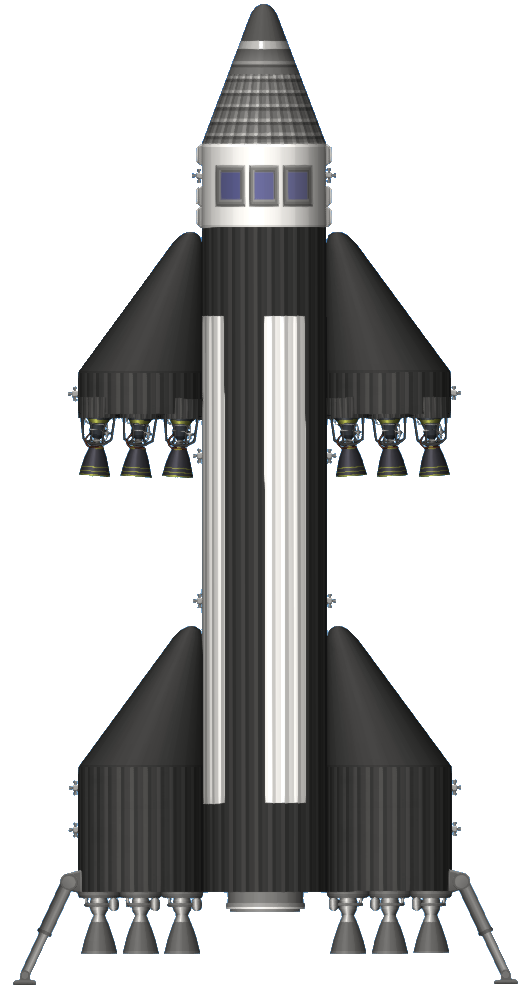
The Imperial Space Administration of the Shazbotdom Empire has developed a modified lunar lander that serves the crucial purpose of transporting crops on the Lunar, Martian, and Venusian Surfaces. This innovative design incorporates a docking port at the bottom, which provides protection against the vacuum of space and harsh environment of Mars and Venus by docking with a specialty docking port on each Lunar, Martian, and Venusian colony.
The primary objective of this modified lander is to ensure the safe and efficient transportation of crops from the Hydroponics Farm Colonies to the Populated Colonies. The docking port, strategically placed at the bottom of the lander, serves as a secure entry point for crops at the end of the journey.
By having the docking port at the bottom, the lunar lander can minimize the risk of exposure to the vacuum of space and Atmosphere of Venus and Mars, which could potentially damage or compromise the crops. The docking port is equipped with advanced sealing technology and reinforced materials, providing an airtight seal and shielding the crops from the harsh conditions of space.
Additionally, the modified lunar lander utilizes state-of-the-art navigation systems and propulsion mechanisms to ensure precise landing and takeoff capabilities. These advancements, coupled with the docking port's protective features, guarantee a safe and reliable transportation process for the crops.
